Last verified: 15 September 2026 · 🔴 volatility for prices/bundles.
Networks
- Safaricom — the largest network, best coverage, first to roll out 5G, and the one tied to M-Pesa. Best default for most visitors.
- Airtel — cheaper bundles, slightly less coverage.
- Telkom Kenya and others exist but are smaller.
Getting a SIM (recommended for most visitors)
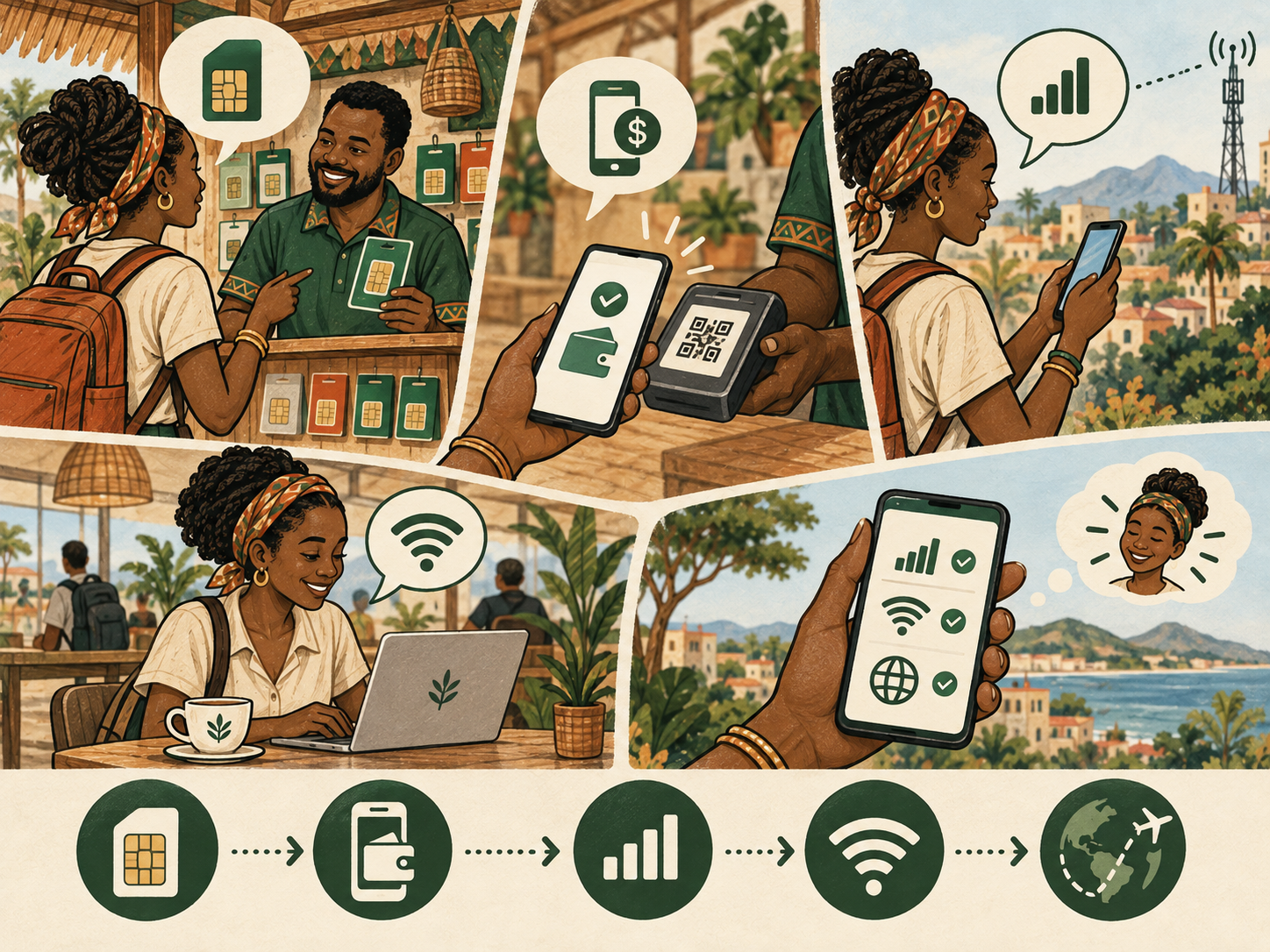
- Where: Safaricom/Airtel outlets at JKIA and Moi (Mombasa) airports, official stores in malls (e.g. Sarit Centre, Westlands), and authorized dealers. Buy only from official/authorized sellers so it's registered correctly.
- Required: your passport — SIM registration is mandatory by law.
- Rough costs (verify): SIM ~KSh 100; data bundles roughly KSh 250–1,000 for ~1–7 GB weekly/monthly tiers; larger monthly bundles available. Tourist-oriented bundles exist.
Sources: Too Many Adapters Kenya SIM guide; JKI Airport. Verified 15 Sep 2026 — bundle prices HIGH volatility.
eSIM options
- Safaricom offers an eSIM (for compatible phones) — you still register with your passport; gets you a local number + M-Pesa capability.
- Travel eSIMs (Airalo, Holafly, Instabridge, etc.) are convenient data-only — quick to set up, prices roughly USD 3.50–42 depending on data/duration.
- ⚠️ Big caveat: most travel eSIMs give you no local phone number, so you can't set up M-Pesa and can't receive calls/SMS from taxi drivers, hotels or tour operators — a real drawback in Kenya's app- and call-driven culture. For a trip longer than a few days, a local Safaricom SIM is usually better than a data-only eSIM.
Coverage & Wi-Fi realities
- Cities and towns: good 4G, growing 5G (Safaricom).
- Remote areas / parks / conservancies: coverage is patchy to none — expect to be offline on safari; lodges may have limited Wi-Fi.
- Wi-Fi: common in hotels, cafés and malls, but speeds/reliability vary — a local data SIM is often more dependable than café Wi-Fi.
- Power cuts happen; keep devices charged and carry a power bank.
Power & plugs
- Plug type: Type G (British three-rectangular-pin).
- Voltage: 230–240 V, 50 Hz. Most laptop/phone chargers are dual-voltage (100–240 V) — fine with just a plug adapter. Check single-voltage appliances (hair tools) need a converter.
- Bring a Type G adapter and, for safaris/remote lodges, a power bank (charging can be limited/solar/timed).
Practical default: a Safaricom SIM (or eSIM) + M-Pesa, set up on arrival with your passport, covers phone, data and payments in one move.