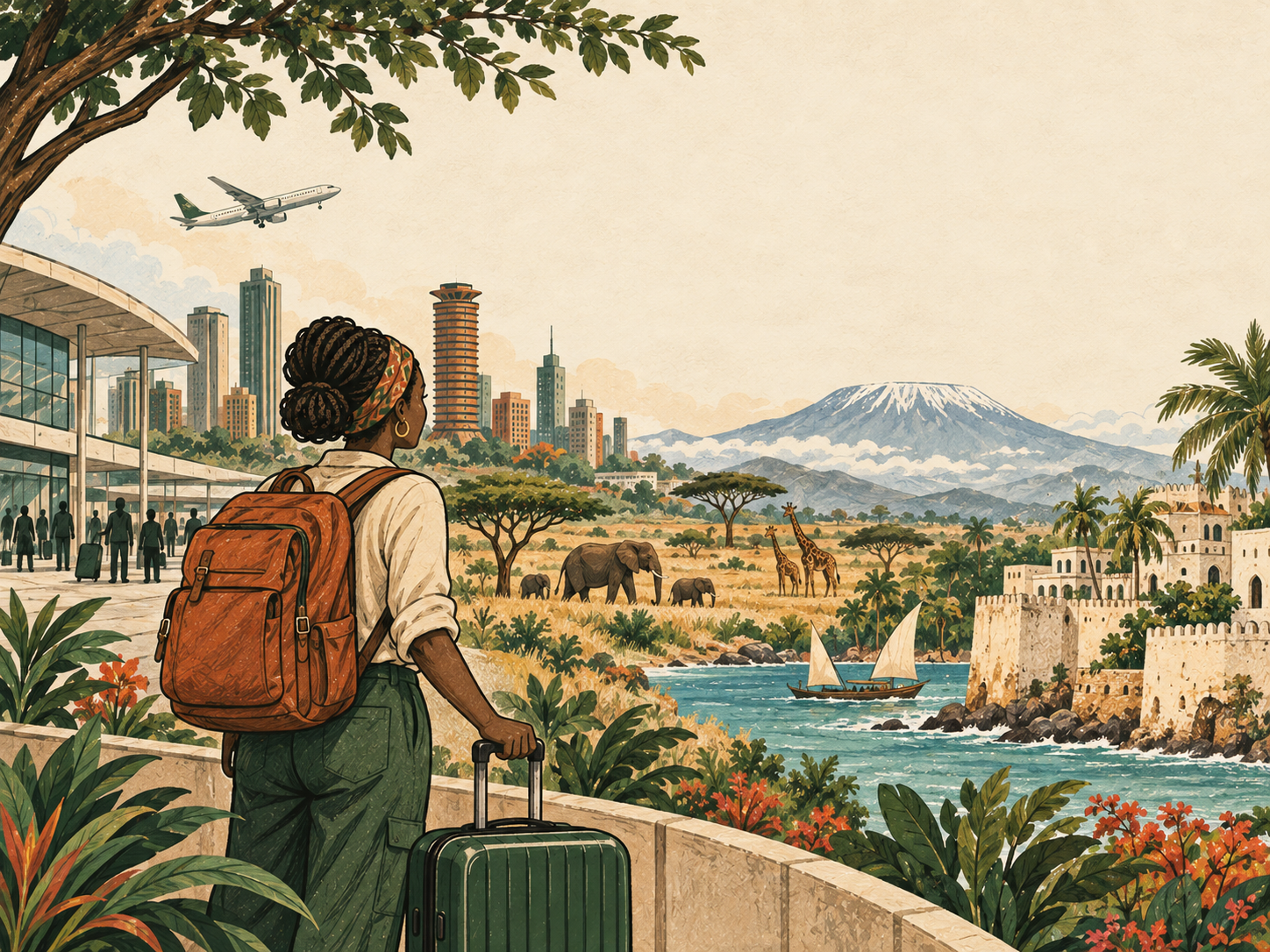
Last verified: 15 September 2026 · 🟢 mostly low volatility (population/leadership are medium).
Fast facts
| Official name | Republic of Kenya (Jamhuri ya Kenya) |
| Capital | Nairobi |
| Largest cities | Nairobi, Mombasa, Kisumu, Nakuru, Eldoret |
| Population | ~58.7 million (2026 est.); median age ~20; ~33% urban |
| Area | ~580,000 km² |
| Counties | 47 (devolved county governments since the 2010 Constitution) |
| Neighbors | Tanzania (S), Uganda (W), South Sudan (NW), Ethiopia (N), Somalia (NE); Indian Ocean coastline (SE) |
| Currency | Kenyan Shilling (KES / KSh) |
| Official languages | English and Kiswahili (Swahili); ~40+ local languages |
| Religion | Majority Christian; significant Muslim minority (esp. coast/northeast); Hindu, Sikh, traditional beliefs |
| Time zone | EAT, UTC+3 (no daylight saving) |
| Electricity | 230–240 V, 50 Hz, Type G plug |
| Driving | On the left |
| Calling code | +254 |
| Independence | 12 December 1963 (from Britain); republic 1964 |
| Government | Presidential republic; President William Ruto (in office since 2022) [verify current leadership near travel] |
Population source: Worldometer (2026). Verified 15 Sep 2026. Other facts are low-volatility.
Geography & landscapes
Kenya packs remarkable variety into one country:
- The coast: white-sand Indian Ocean beaches, coral reefs, mangroves, and Swahili towns (Mombasa, Diani, Watamu, Malindi, Lamu).
- The Rift Valley: dramatic escarpments and a chain of lakes — Nakuru, Naivasha, Bogoria, Turkana (the world's largest desert lake).
- Highlands: fertile, cool, tea/coffee country around Mt Kenya (5,199 m — Africa's 2nd-highest) and the Aberdares.
- Savannah plains: the iconic wildlife country — Maasai Mara, Amboseli, Tsavo, Samburu.
- Arid north: vast semi-desert (Turkana, Marsabit) with distinct cultures.
- Lake Victoria in the west (shared with Uganda & Tanzania) — Kenya's largest lake.
- The Equator runs through the country (near Nanyuki).
Climate & seasons (general — verify by region)
Being on the equator, temperatures vary more by altitude than by season.
- Long rains: roughly March–May.
- Short rains: roughly October–December.
- Dry seasons: roughly Jan–Feb and June–September — Jun–Oct is prime for the Maasai Mara wildebeest migration and generally the classic safari window.
- Coast: hot and humid year-round.
- Highlands/Nairobi: mild days, cool nights (Nairobi ~10–26 °C typically).
Climate is shifting and rains can be erratic — check current forecasts and road conditions for your dates.
People & culture snapshot
- Ethnic diversity: dozens of communities — including Kikuyu, Luhya, Kalenjin, Luo, Kamba, Kisii, Meru, Maasai, Somali, Mijikenda, Swahili and many more — each with its own language and traditions. (See "Understanding Kenyans".)
- Language in practice: English is used in business, education, signage and by most people in tourism; Kiswahili is the national lingua franca; "Sheng" (a Swahili-English street slang) is big among urban youth.
- Contemporary culture: a vibrant scene in music (benga, genge, gengetone, Afro-pop, gospel), literature (Ngũgĩ wa Thiong'o, Grace Ogot, contemporary writers), film/TV (Riverwood, Nairobi's creative scene), fashion/design, and a globally-known long-distance running tradition (Kalenjin runners).
- Tech: Nairobi is a major African tech hub ("Silicon Savannah") — birthplace of M-Pesa, home to startups and innovation centers.
Economy (context)
Agriculture (tea, coffee, horticulture/cut flowers, dairy), tourism, services and a fast-growing tech/mobile-money sector; Mombasa's port is a regional gateway.
National symbols & holidays
- Flag: black (people), red (struggle for freedom), green (land), with white fimbriations and a Maasai shield and spears at center.
- National holidays include: New Year; Good Friday & Easter Monday; Labour Day (1 May); Madaraka Day (1 June); Mashujaa/Heroes' Day (20 Oct); Jamhuri/Independence Day (12 Dec); Christmas (25 Dec) & Boxing Day; plus Idd/Eid dates for the Muslim community.
[Confirm exact dates yearly — some are movable.] - Working week: generally Monday–Friday, with Saturday morning trading common; many businesses open Saturdays. Sundays are quieter (many shops/malls still open in cities). Friday afternoons are prayer time for Muslims, especially at the coast.
This is the "dream/understand" entry point. For deeper cultural nuance see understanding-kenyans.md; for regions see the county template/overview.