Last verified: 15 September 2026 · 🟢 low volatility (fundamentals), 🟡 for social specifics.
Kenya is not one homogeneous culture. It's a nation of many communities, regions, faiths, generations and lifestyles. Treat what follows as orientation, not stereotype — individuals vary enormously, and urban Nairobi differs from a rural village as much as any two places on earth.
Diversity first
- Many peoples, many languages: dozens of ethnic communities, each with distinct languages, food, music and customs — bound together by English and Kiswahili and a strong national identity.
- Regional identities: coastal Swahili culture (Islamic influence, dhows, Swahili architecture and cuisine) feels different from the highland farming communities, the pastoralist Maasai/Samburu/Turkana, or lakeside Luo/Luhya country.
- Urban vs rural: Nairobi is fast, cosmopolitan, tech-savvy and multilingual (with its own "Sheng" slang and youth culture); rural life is more traditional and community-centered.
- Generational shift: a very young population — energetic, online, entrepreneurial, globally connected — alongside deep respect for tradition and elders.
Social interaction & etiquette
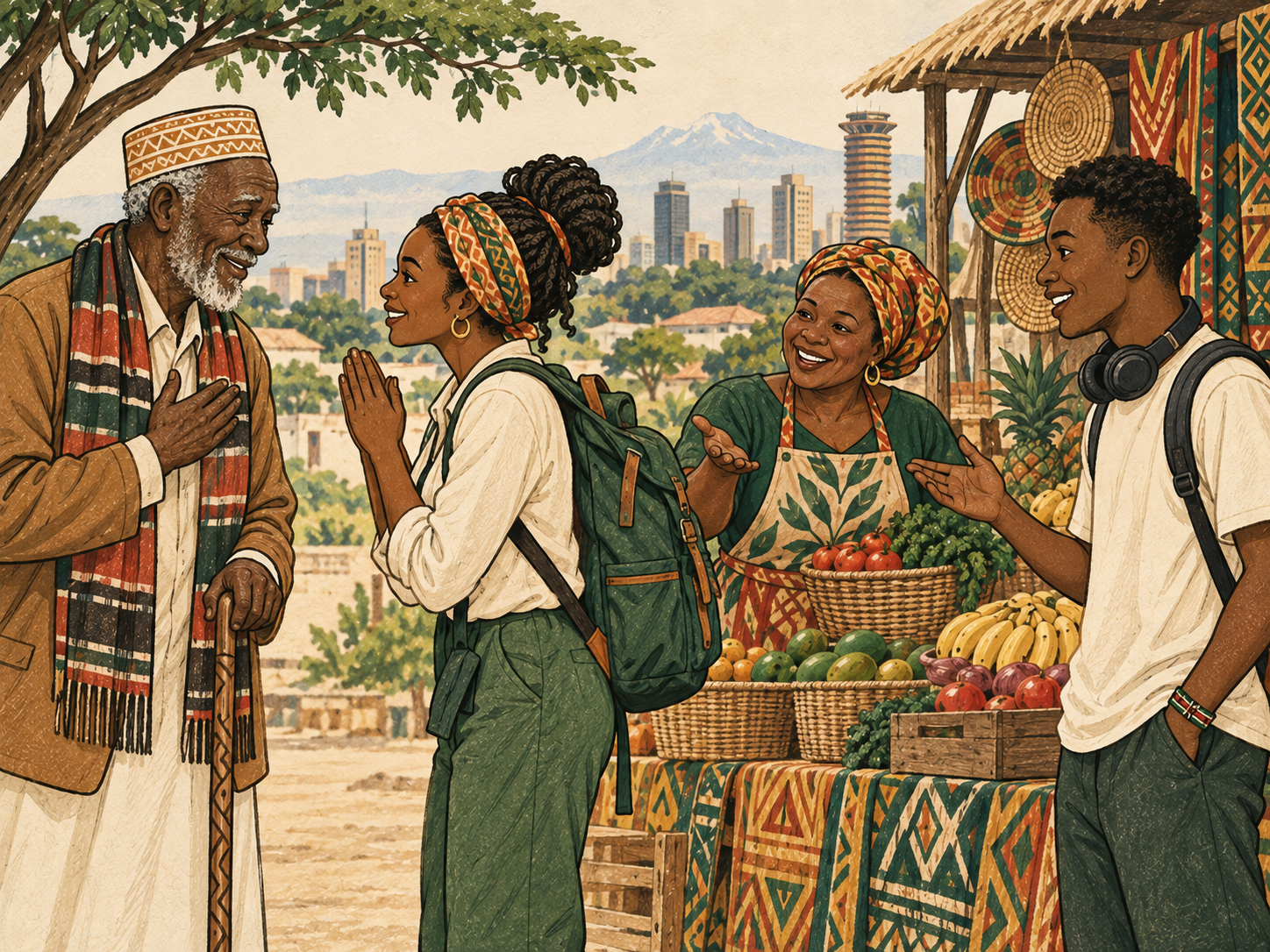
- Greetings matter — a lot. Take time to greet before getting to business. Common openers: "Jambo" (hello, touristy), "Habari?" (how are you?), "Mambo?" (what's up? — casual), reply "Poa"/"Nzuri"/"Salama". A handshake is standard, often warm and lingering; close friends may do a hand-clasp variation.
- Respect for elders: greet elders first; address an older man as "Mzee", and use "Mama" / "Baba" (mother/father) or "Auntie"/"Uncle" respectfully. Slight bowing/deference toward elders is appreciated.
- Warmth & hospitality: Kenyans are widely known for friendliness and generosity; guests are treated well. If invited to a home, it's a genuine honor.
- Humor: banter, teasing and laughter are part of daily life; a friendly, relaxed manner goes far.
- Communication style: tends to be polite and indirect; blunt confrontation or public anger is frowned upon. "Pole pole" ("slowly slowly") captures a relaxed pace — patience is a virtue.
- Time ("African time"): punctuality is valued in formal/business settings, but social timing can be flexible — don't be surprised by delays.
- Personal space & the right hand: use your right hand (or both) for greetings, giving/receiving, and eating; the left hand alone can be seen as impolite.
Visiting homes & invitations
- Bring a small gift (tea, sugar, pastries, or something from your home country) if invited to a meal.
- You may be offered chai (tea) and food — accepting is polite; finishing your plate shows appreciation (wasting food can seem disrespectful).
- Remove shoes if others do; follow your host's lead.
Dress
- Cities/safari: casual Western dress is fine.
- Rural areas & the Muslim-majority coast (Mombasa, Lamu, Malindi): dress modestly — cover shoulders and knees; women may carry a kanga/scarf. Beachwear stays on the beach/resort. In Lamu especially, modest dress is expected in town.
Photography etiquette
- Always ask before photographing people — especially Maasai, Samburu and Swahili communities; some will decline or expect a small payment (common and fair for posed photos). A genuine interaction first goes a long way.
- Do NOT photograph: government/military installations, police, airports' secure areas, and some official buildings — this can cause serious trouble. (See photography rules in safari file too.)
Money manners
- Tipping: ~10% at restaurants if not already added; tip safari guides/drivers, hotel porters and housekeeping modestly; rounding up taxis is fine; no tipping in matatus.
- Bargaining: expected in markets and with informal taxis/curios — do it good-naturedly and pay fairly; not in supermarkets, malls, fixed-price shops, or for official fees.
- Gift-giving: small, thoughtful gifts are welcomed; avoid ostentation.
Sensitive topics & conduct
- Public displays of affection are best kept minimal (and carry real risk for same-sex couples — see traveler-groups file).
- Politics and ethnicity can be sensitive — listen more than you opine; avoid taking sides.
- Religion is important to many — be respectful around worship and dress at religious sites.
- Alcohol: widely available in bars/restaurants/clubs in cities and resorts, but drinking is less prevalent in Muslim coastal communities and some rural/religious contexts — read the setting.
Immersion done right — "Experience Kenya, don't just see it"
Kenya rewards travelers who engage respectfully. Great immersive experiences include community-led cultural visits, cooking classes, coffee/tea-farm tours, craft workshops (beadwork, weaving, pottery), music/dance/storytelling, markets, matatu culture, and Nairobi's art, fashion and tech scenes.
Do it respectfully:
- Prefer community-led / community-owned experiences where income actually reaches the community (ask how it's structured).
- Be wary of staged "authenticity" and of turning people into a spectacle — engage as a guest, not a spectator.
- Ask before photographing; follow the community's rules.
- Avoid "orphanage tourism" and short-term volunteering that can do harm — choose established, ethical organizations if volunteering.
Responsible tourism (quick charter)
- Wildlife ethics: keep your distance, never feed animals, avoid attractions that exploit animals; choose conservancies/operators that fund conservation and communities.
- Environment: respect the plastic-bag ban and single-use-plastic rules in parks/beaches; don't litter; conserve water.
- Community: buy local and fair; hire local guides; respect customs and consent.
- Cultural respect: dress and behave appropriately; learn a few Swahili words (see phrasebook) — it's genuinely appreciated.
Sources: Adventure Horizons etiquette guide; widely-corroborated cultural guidance. Verified 15 Sep 2026. Where possible, future edits should draw on Kenyan writers, cultural institutions and local contributors, and continue to avoid stereotyping.